
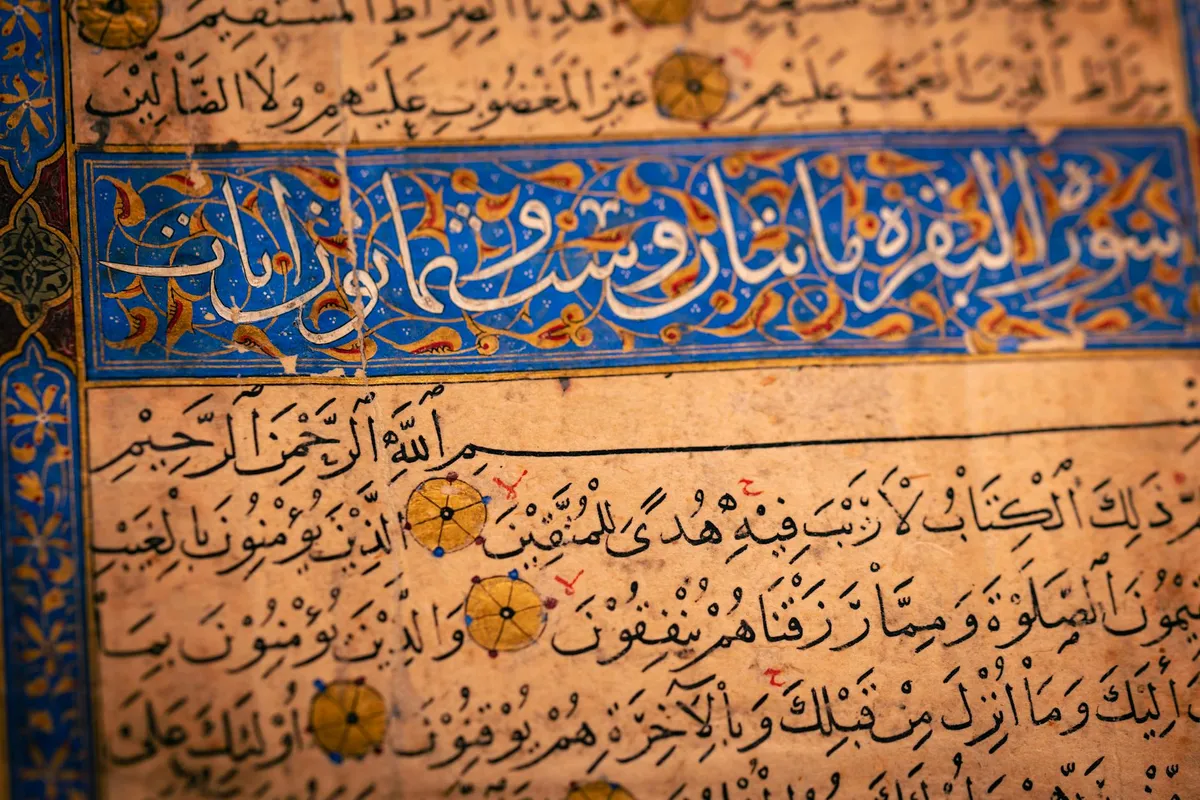
Persian miniature painting developed across roughly seven centuries (13th through 19th) as a sophisticated visual tradition with its own conventions, vocabularies, and aesthetic priorities. Western viewers encountering miniatures often apply Western pictorial expectations and miss what the works actually accomplish. This article presents a framework for analyzing Persian miniatures that helps viewers see the works on their own terms.
The conventions Western viewers commonly miss
Multiple perspectives within a single image. Persian miniatures routinely combine multiple viewpoints in one composition — buildings shown from above, figures shown from the side, distant landscapes brought forward. Western linear perspective is largely absent. The convention is not failure to achieve perspective; it's a deliberate choice that allows the painting to show more than a single viewpoint could.
Color symbolism over naturalistic color. Sky in Persian miniatures is often gold rather than blue. Tree leaves may be conventional rather than seasonal. Water may be pure blue without naturalistic detail. The colors carry symbolic meaning rather than naturalistic accuracy. Reading them naturalistically misses what they convey.
Narrative integration. Multiple moments of a single narrative often appear within one composition — a hunt scene may show the chase, the kill, and the celebration simultaneously. The unity is narrative rather than temporal; viewers read the painting across the story rather than as a single moment.
Hierarchy through scale. Important figures (kings, prophets, saints) are often larger than less-important ones, regardless of spatial position in the image. The scale conveys cultural importance rather than physical size.
Decorative density. Persian miniatures often fill the entire image surface with detail — patterned backgrounds, textile patterns on figures, decorative borders. The density is intentional; empty space is not the goal.
The framework for analysis
For viewers analyzing a Persian miniature, the framework that helps:
- Identify the narrative. Most miniatures illustrate a specific scene from literature, history, or religious tradition. Knowing the narrative is the precondition for understanding the composition.
- Locate the central figures. The composition usually has a focal arrangement of key figures. Identify them and their relationships.
- Read the spatial logic. Notice how the multiple perspectives combine. Don't expect coherent linear perspective; expect a compositional logic that prioritizes showing the narrative over showing physical space.
- Attend to color symbolism. Note the colors used and where. Reference texts on Persian color symbolism explain the conventions.
- Examine decorative detail. The patterns and details often carry meaning — specific textiles indicate specific characters; specific architectural details indicate specific places.
- Place within tradition. The miniature belongs to a specific period and school. Knowing which helps interpret the choices the artist made.
The major schools and periods
Persian miniature painting developed in identifiable schools, each with distinct characteristics:
The Mongol period (13th-14th c.) — early development with substantial Chinese influence visible in landscape conventions and figure types.
The Timurid period (14th-15th c.) — refinement of conventions; the Herat school under Bihzad produced some of the tradition's great works.
The Safavid period (16th-17th c.) — peak development; the Tabriz school and later the Isfahan school produced extensive royal manuscript illustration.
The Qajar period (18th-19th c.) — late development with European influence visible in some works; produced both traditional miniature work and hybrid forms.
Knowing the school and period helps interpret specific choices. A Tabriz Safavid miniature has different conventions than a Qajar one.
What miniatures were for
Persian miniatures were primarily manuscript illustration. They appeared in books — copies of the Shahnameh, the Khamsa of Nizami, religious texts, royal histories. The miniature accompanied the text; the visual and textual together produced the experience.
This context matters for understanding individual works. The miniature wasn't designed as standalone art; it was designed as part of a manuscript. Viewing miniatures isolated from their textual context misses something the original viewers experienced.
Engaging with miniatures today
Most major museums with Islamic art collections include Persian miniatures. The Met (New York), the Louvre (Paris), the British Museum (London), the Museum of Islamic Art (Doha), and the Reza Abbasi Museum (Tehran) all have substantial collections accessible to visitors.
For deeper engagement, manuscript facsimiles and scholarly editions allow viewing of complete manuscripts in their original sequencing. The text-image relationship becomes accessible in ways that isolated miniatures cannot show.
The closing observation
Persian miniature painting rewards engagement on its own terms. Viewers who apply Western pictorial expectations see only what the works lack from the Western perspective; viewers who engage with the conventions see what the works actually accomplish.
The framework above is a starting point. Sustained engagement with the tradition — through museums, manuscripts, scholarly literature — produces appreciation that brief exposure cannot.
Source notes
Framework draws on the published scholarship including Sheila Blair and Jonathan Bloom, The Art and Architecture of Islam: 1250-1800 (Yale, 1995); David Roxburgh, The Persian Album, 1400-1600 (Yale, 2005); and the catalogue traditions of the major museum collections of Persian art.